
Snuffing vs. Blowing Out a Candle: The Better Way to Put Out a Flame
Most of us put out candles the way we did as kids: one big breath. It works, but it is not the best way to treat a candle you paid good money for. Here is what happens when you blow out a flame, why smothering it is the better option, and a few habits that help your candles burn evenly to the end.
What happens when you blow out a candle
A hard breath does two things. It can push hot, liquid wax up the sides of the jar or onto the table, and it leaves the wick smoldering, which sends a trail of smoke into the room. In a jar candle, that smoke tends to settle on the glass and darken it over time.
Why smothering the flame is better
A flame needs oxygen. Cover it and it goes out on its own, without disturbing the wax. That is the idea behind a candle snuffer and behind a candle lid: cut off the air and the flame stops. You keep the melt pool smooth and avoid blowing wax around.
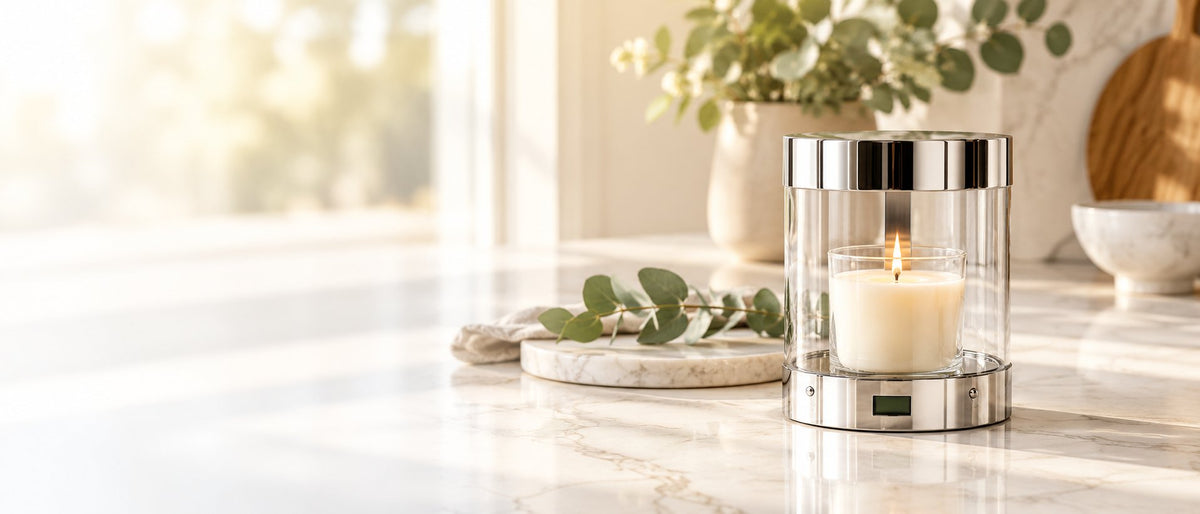
The catch with a snuffer or a separate lid is that it is one more thing to keep track of. That is why we designed ALEC with the lid built in. You set a timer on the base, and when time is up the lid closes over the candle and the flame goes out. ALEC's timed, self-closing lid is protected by U.S. Patent No. 10,544,938 and European Patent EP 3491291.
Simple habits for a better burn
- Trim the wick. Before each burn, trim the wick to about 1/4 inch. A long wick makes a tall, flickering flame.
- Let the first burn reach the edges. On a new candle, let the melted wax reach the sides of the jar before putting it out. This helps prevent tunneling.
- Do not burn for too long. Follow the burn time on your candle's label. Many candle makers recommend no more than about four hours at a time.
- Keep it away from drafts. Drafts cause uneven burning and flickering.
- Let it cool before moving it. Wait until the wax has set and the jar is cool.
Safety first
Whatever method you use, never leave a burning candle unattended, keep it away from anything that can catch fire, and keep it out of reach of children and pets. A timer and lid are a convenience, not a replacement for supervision. Read more in our candle safety guide.